By Dr Ebiye-Nwoko Adaeze (OD)
Most people who wear contact lenses will encounter this sooner or later. You come home after an exhausting day navigating the heavy traffic on the Lagos-Abeokuta Expressway, or you finish a late-night work project in your home office. You feel your eyelids growing heavy, and the comfort of your bed is calling. Many people tell themselves, “It’s only for a short nap,” or “Surely one night won’t cause any problems.” The next morning, you wake up with your eyes feeling sticky, bloodshot, and dry. You peel the lenses off your irritated corneas and move on with your day, assuming you got away with a harmless shortcut.
But as any optometrist will tell you, sleeping in contact lenses even for just one night is akin to playing Russian roulette with your sight.
At IrisCare Eye Clinic, Dopemu, Agege, Lagos, we regularly encounter patients who treat overnight contact lens wear as a minor bad habit. In reality, it is one of the leading triggers for severe, rapid, and sometimes irreversible corneal damage. Your eyes require a constant supply of oxygen and a highly specialized defense system to stay healthy, and a closed eyelid over a plastic lens completely destabilizes that delicate balance. Let’s look at the biological consequences of sleeping in your contacts and why a single night of neglect can change your vision forever.
The Choking Eye: Understanding Corneal Hypoxia
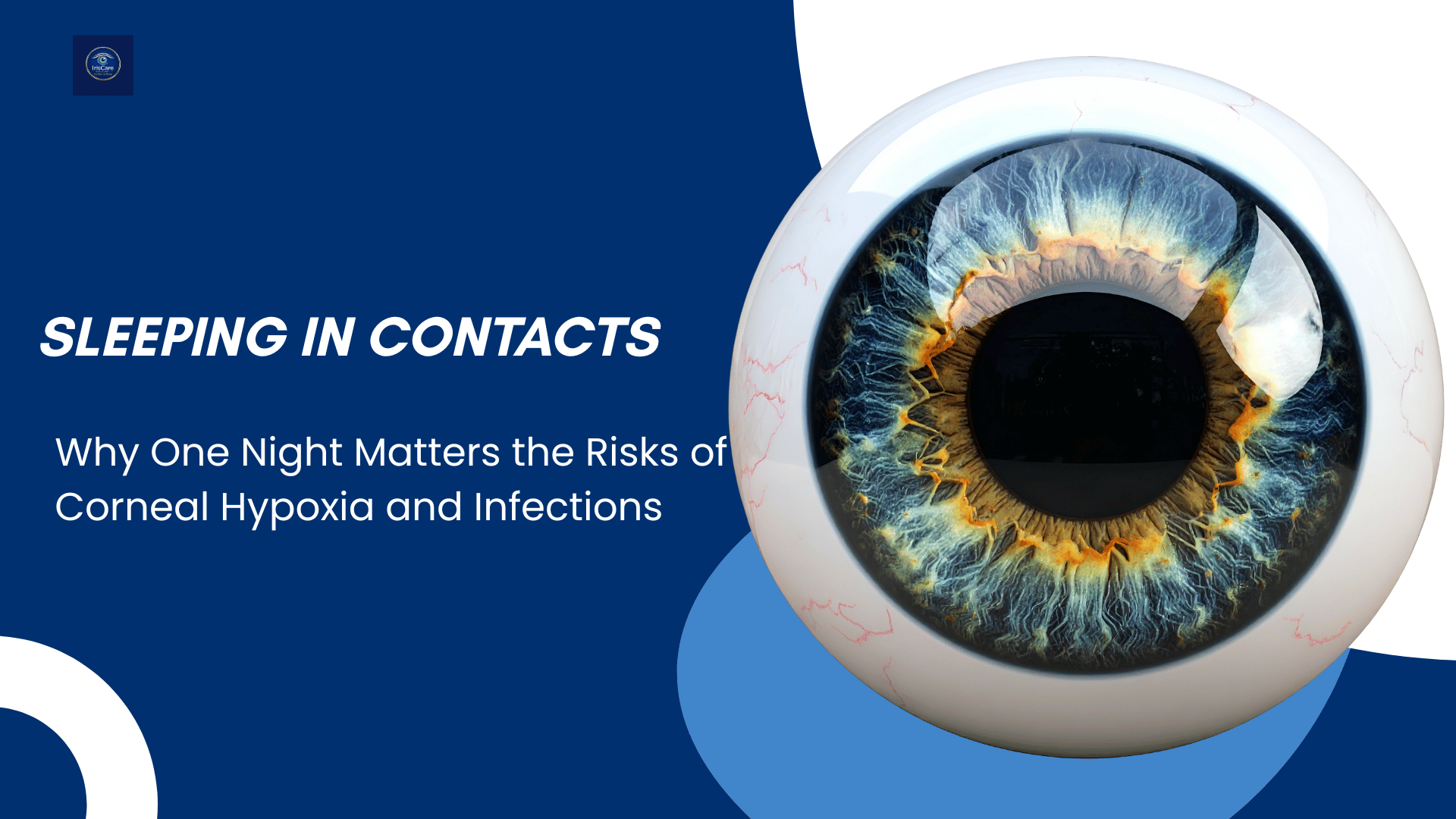
To understand why sleeping in your contacts is so dangerous, you first need to understand how your eyes breathe. Most organs in the human body receive their oxygen directly from the bloodstream. The cornea, the clear curved surface at the front of your eye, is a remarkable structure. It contains no blood vessels in order to stay clear and allow light to pass through without obstruction.
The Atmospheric Oxygen Loop
Instead, your cornea absorbs its oxygen directly from the outside air, dissolved in your natural tear film. When you are awake, every blink locks in fresh oxygen from the atmosphere.
When you close your eyes to sleep, your cornea’s primary oxygen supply is cut off. The eye must rely on a significantly lower concentration of oxygen supplied by the blood vessels on the inside of your eyelids. Now, imagine placing a plastic barrier, a contact lens directly over the cornea, and then closing your eyelid on top of it. You have effectively trapped the cornea in a zero-oxygen environment. This condition is medically known as corneal hypoxia.
The Cascade of Hypoxic Damage
According to a clinical study published in Contact Lens and Anterior Eye (2025), prolonged overnight corneal hypoxia forces the cornea into anaerobic metabolism. This shift causes a rapid accumulation of lactic acid, which triggers a biological chain reaction:
- Corneal Edema: The cornea absorbs fluid and swells, leading to foggy or hazy vision when you wake up.
- Epithelial Micro-Cysts: Tiny, fluid-filled bubbles form on the outer protective layer of the eye.
- Neovascularization: As a response to oxygen starvation, abnormal blood vessels can begin growing into the cornea, which is usually free of them. If left unchecked, these vessels can encroach on your line of sight, causing permanent visual degradation.
The Microscopic Battleground: Overnight Infections
Your eyes are constantly exposed to airborne bacteria, fungi, and amoebas. When you are awake, your tear film acts as a dynamic cleansing system. Every blink flushes away micro-particles, and your tears contain natural antibacterial enzymes (like lysozyme and lactoferrin) that actively kill pathogens.
The Stagnant Pond Effect
When you sleep, your tear production plummets, and mechanical blinking stops. If you leave a contact lens in your eye overnight, you create what optometrists call the “stagnant pond effect.”
By sitting on the eye, the lens can trap microorganisms beneath it and allow them to remain in contact with the cornea. Starved of oxygen, the outer protective cells of your cornea (the epithelium) loosen and develop microscopic tears. These microscopic injuries create an entry point for bacteria and other pathogens.
Research from a global database analysis published in Ophthalmology confirmed that individuals who sleep in their contact lenses are 20 times more likely to develop Microbial Keratitis (a severe, rapidly progressing corneal infection) than those who remove them before bed.
The Ultimate Threat: Pseudomonas Aeruginosa
At IrisCare Eye Clinic, Dopemu, Agege, Lagos, the pathogen we fear most in overnight lens wearers is Pseudomonas aeruginosa. This aggressive strain of bacteria is well adapted to low-oxygen settings. Once it enters a hypoxic corneal micro-tear, it releases enzymes that can literally digest corneal tissue. Within 24 to 48 hours, Pseudomonas can cause a deep corneal ulcer, leading to permanent structural scarring or complete perforation of the eyeball.
Acanthamoeba: The Tap Water and Dusty Wind Compunder
Living and working in a bustling tropical metropolis like Lagos introduces unique environmental risks for contact lens wearers. In areas around Agege and Dopemu, airborne dust, harmattan particles, and variations in clean municipal water storage mean that our eyes are regularly exposed to hardy environmental pathogens like Aanthamoeba, a microscopic, tissue-eating amoeba found in soil and water.
If you wear your contact lenses in the shower, wash them in tap water, or expose your eyes to dusty winds, and then go to sleep with those lenses in, you create a perfect incubator. A 2026 review published in the International Journal of Ophthalmic Practice found a marked surge in Acanthamoeba keratitis linked to inadequate daily lens hygiene among hybrid workers. This infection is notoriously difficult to treat, often requiring months of hourly eye drops, and frequently results in the need for a corneal transplant to restore sight.
The Signs of Trouble: What to Look For
If you have slept in your contacts, you need to monitor your eyes with extreme vigilance over the next 48 hours. Remove the lenses immediately and seek an optometrist if you notice any of the following “red flag” symptoms:
- The RSVP Rule: Redness, Severe pain, Vision changes (blurriness), or Photophobia (extreme sensitivity to light).
- A gritty, unyielding foreign-body sensation, as if an eyelash is permanently stuck in your eye.
- Thick, yellow, white, or green discharge leaking from the eyelids.
- A visible white or gray spot on the colored part of your eye (an indicator of a corneal ulcer).
Important Clinical Warning: Never insert comfort drops or re-wetting drops over a painful eye to try and “soothe” it after sleeping in your lenses. If an infection has started, masking the symptoms with self-medication only delays life-saving professional treatment.
Comprehensive Care and Prevention at IrisCare Eye Clinic
At IrisCare Eye Clinic, Dopemu, Agege, Lagos, located inside Greater Path Mall, 155 Dopemu Road, we don’t believe in scolding our patients. We believe in providing advanced clinical solutions and structural education to keep your vision safe.
Advanced Slit-Lamp Biomicroscopy
If you accidentally sleep in your lenses and wake up with discomfort, our experienced optometrist team can perform a detailed microscopic exam using specialized fluorescent dyes. This allows us to spot microscopic hypoxic changes or early bacterial colonies before they blossom into deep, sight-threatening ulcers.
Precision Daily Disposable Fittings
If your busy schedule or long commute through Lagos traffic makes a nightly cleaning routine unrealistic, let’s change your lens strategy. Our dispensing specialists can fit you with modern Daily Disposable Contact Lenses. Because you throw these away every single night before sleep and open a completely fresh, sterile blister pack every morning, your risk of developing a devastating corneal biofilm drops dramatically.
The Emergency Contact Protocol
We are a dedicated part of the Dopemu and Agege community. If you develop an eye emergency after sleeping in contact lenses, our clinic offers prompt assessments and urgent treatment to control infection and protect your corneal health.
Conclusion: Protect Your Windows to the World
Your corneas are living, breathing tissues that demand oxygen and care to grant you the gift of clear vision. While modern contact lenses are marvels of material science, they are medical devices—not toys. Slipping up and sleeping in your contacts for “just one night” strips your eyes of their natural defenses, leaving them completely vulnerable to starvation and aggressive pathogens.
Make a non-negotiable pact with yourself today: no matter how tired you are, no matter how late it is, the lenses must come out before your head hits the pillow. Your sight is far too valuable to lose for a few minutes of convenience.
If you are experiencing chronic redness from your contact lenses, or if you want to explore safer, more breathable lens options tailored to your lifestyle, come see us. Visit IrisCare Eye Clinic today, and let’s keep your eyes healthy, hydrated, and brilliantly clear.
Contact IrisCare Eye Clinic Today At Greater Path Mall, 155 Dopemu Road, Dopemu, Agege, Lagos.
Phone Contact: +234 916 001 0549
Schedule your comprehensive contact lens wellness checkup today!
Citations and Peer-Reviewed References
- Contact Lens and Anterior Eye (2025). “Corneal swelling profiles, lactic acid accumulation, and epithelial micro-cyst development under extended hypoxic stress conditions.”
- Ophthalmology (2025). “The risk metrics of microbial keratitis in overnight contact lens wear: A global database analysis.”
- International Journal of Ophthalmic Practice (2026). “Acanthamoeba keratitis vectors in rapidly urbanizing tropical microclimates: A clinical review.”
- Journal of Ophthalmic Microbiology (2025). “Enzymatic degradation kinetics of Pseudomonas aeruginosa on compromised corneal epithelial basements.”