By Dr Ebiye-Nwoko Adaeze (OD)
Introduction
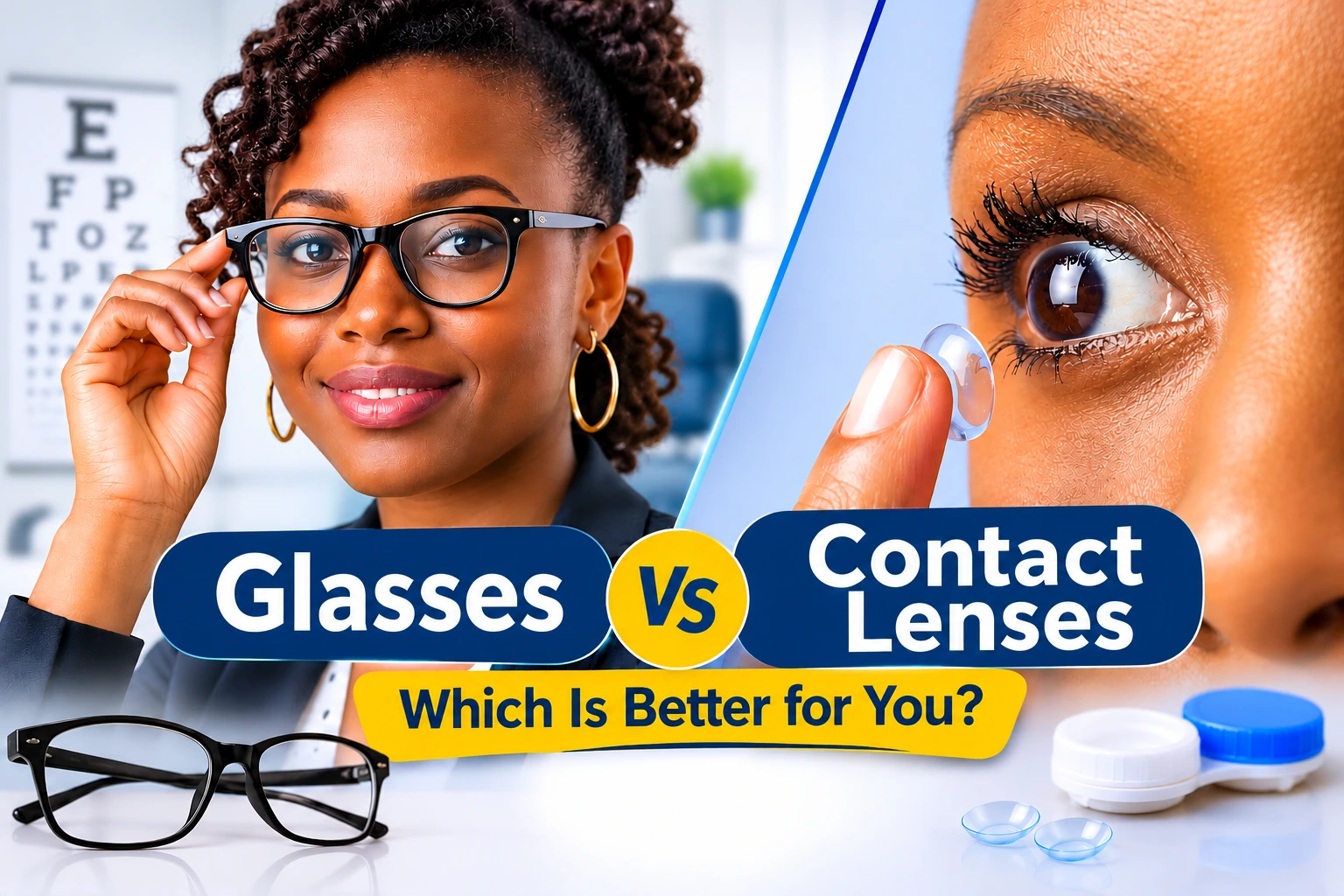
If you need vision correction, you may have wondered whether contact lenses or prescription glasses are the better choice. Perhaps you want a more convenient option for work, a more comfortable way to participate in sports, or eyewear that suits your everyday lifestyle.
The truth is that both contact lenses and glasses can provide excellent vision correction, but the better option depends on your eye health, prescription, daily activities, comfort and budget. Neither is universally superior, and some people benefit from using both.
At IrisCare Eye Clinic, Dopemu, Lagos, we believe that choosing the right vision correction should begin with a proper eye examination and an understanding of your individual needs. In this guide, we compare contact lenses and glasses to help you make an informed decision.
What is the difference between contact lenses and glasses?
Prescription glasses correct refractive errors using lenses positioned in a frame in front of your eyes. Contact lenses are thin optical devices that sit directly on the tear film covering the cornea, the transparent front surface of the eye.
Both can correct common refractive errors, including:
– Myopia (short-sightedness): Difficulty seeing distant objects clearly.
– Hyperopia (long-sightedness): Difficulty focusing comfortably at near, depending on the degree and age of the individual.
– Astigmatism: Blurred or distorted vision resulting from differences in the eye’s focusing power across different meridians.
– Presbyopia: An age-related reduction in the eye’s ability to focus on near objects.
The National Eye Institute and American Academy of Ophthalmology recognise both glasses and contact lenses as effective methods of correcting refractive errors.
Benefits of wearing prescription glasses
Glasses remain a popular choice because they are convenient, easy to maintain and available in many styles.
Advantages of glasses
– Easy to use: You can put them on and take them off without touching your eyes.
– Low maintenance: They do not require contact lens solutions, disinfecting or daily insertion and removal routines.
– Protection: Glasses provide a physical barrier against some dust and airborne particles. Protective eyewear is still needed for hazardous work and activities.
– Multiple lens options: Depending on your prescription, you may choose single-vision, bifocal, progressive, photochromic or specialised lenses.
– Generally lower ongoing costs: A pair of glasses can last a long time if properly maintained, although replacement may be needed if your prescription changes or the lenses become damaged.
Glasses can be particularly suitable for people with dry eyes, frequent eye irritation or difficulty maintaining the hygiene required for contact lens wear.
Are there disadvantages?
Glasses can fog up in humid conditions, become inconvenient during sports and get splashed during rainy weather. They may also slide down the nose, collect dust or restrict some peripheral vision. High prescriptions can produce thicker lenses or noticeable image-size effects, depending on the prescription and lens design.
For many people, however, the convenience and low maintenance of glasses make them an excellent everyday option.
Benefits of wearing contact lenses
Contact lenses offer a different experience because they move with your eyes rather than sitting in a frame.
Advantages of contact lenses
– Wider field of view: Contact lenses can provide a more natural peripheral field of vision because there are no spectacle frames at the edges.
– Convenience during sports: Properly fitted lenses stay in place during many physical activities and do not slide down your nose.
– No fogging: They do not fog up like glasses when moving between air-conditioned rooms and humid outdoor environments.
– Natural appearance: Some people prefer their appearance without spectacle frames.
– Prescription flexibility: Specialised lenses can correct astigmatism, presbyopia and certain irregular corneal conditions, depending on the individual.
These benefits are recognised by the Centers for Disease Control and Prevention (CDC) and the American Academy of Ophthalmology.
What are the disadvantages?
Contact lenses require careful handling, correct fitting and regular replacement. Poor hygiene or wearing them longer than recommended can increase the risk of corneal infection, including microbial keratitis, which may threaten sight.
Some wearers also experience dryness, irritation or discomfort, particularly in challenging environments. Dust, smoke, air conditioning and prolonged screen use may worsen symptoms in susceptible individuals.
Contact lenses therefore require more responsibility than simply putting on a pair of glasses.
Contact lenses vs glasses: Which is better?
There is no single winner for every patient. The most appropriate option is the one that provides clear, comfortable vision while fitting your eye health, lifestyle and ability to follow the required care routine.
Which option is best for your lifestyle?
Your everyday activities can help guide your choice.
- For students and office workers
Glasses may be a convenient option for reading, studying and working at a computer. Contact lenses can also work well, but prolonged screen use may reduce blinking and contribute to dryness. Regular visual breaks and conscious blinking can help.
- For sports and active lifestyles
Contact lenses can offer a wider field of view and greater freedom of movement. However, protective sports eyewear may still be necessary. Swimming and water sports require special precautions because water can expose contact lenses to harmful microorganisms.
- For people with high prescriptions
Both glasses and contact lenses may provide good vision, but the optical effects can differ. Contact lenses may reduce some image-size differences and spectacle-related distortions. Specialised fitting is important, particularly for complex prescriptions.
- For people with dry eyes or allergies
Glasses may be more comfortable if contact lenses aggravate dryness or irritation. Some people can still wear specially selected contact lenses after an eye-care professional assesses and manages the underlying problem.
- For people who prefer flexibility
You do not necessarily have to choose only one. Many people wear contact lenses during the day and keep prescription glasses for home use, evening wear or occasions when their eyes need a break.
Are contact lenses safe?
Yes, contact lenses can be safe and effective when prescribed, fitted and used correctly. However, they are medical devices, not merely cosmetic accessories.
A 2021 article by Kates and Tuli in JAMA discussed contact lens complications, including discomfort and potentially serious eye infections. The CDC also emphasises that incorrect wearing, cleaning and storage practices increase the risk of infection.
To reduce your risk:
1. Wash and dry your hands before handling your lenses.
2. Follow the prescribed wearing schedule and replacement instructions.
3. Never sleep in contact lenses unless your eye-care professional has specifically prescribed an appropriate overnight-wear lens and schedule.
4. Keep contact lenses away from tap water, swimming pools and shower water.
5. Use the recommended contact lens disinfecting solution; never use saliva or homemade solutions.
6. Do not reuse old solution or simply top it up with fresh solution.
7. Attend your recommended contact lens follow-up appointments.
8. Keep a pair of up-to-date prescription glasses as a backup.
If you experience eye pain, redness, light sensitivity, discharge or sudden blurred vision while wearing contact lenses, remove them and seek urgent eye-care advice. Do not put them back in until you have been advised it is safe.
Why a professional eye examination matters
Before choosing contact lenses, you need more than a spectacle prescription. An appropriate contact lens assessment may include:
– A comprehensive eye examination and refraction.
– Assessment of the cornea and tear film.
– Corneal measurements and evaluation of lens fit.
– Selection of a suitable lens material, design and wearing schedule.
– Training on insertion, removal, hygiene and lens care.
– Follow-up assessment to check comfort, vision and eye health.
This is particularly important if you have astigmatism, dry eyes, an irregular cornea or a history of eye disease.
At IrisCare Eye Clinic, Dopemu, Lagos, an individual assessment can help determine whether glasses, contact lenses or a combination of both best meets your visual needs. The aim is not simply to help you see clearly, but to support comfortable and healthy vision over time.
What about the cost of contact lenses and glasses in Lagos?
The cost varies according to your prescription, lens design, frame selection, contact lens material, and replacement schedule and aftercare requirements.
Glasses may involve a higher initial purchase cost but relatively low ongoing expenses. Contact lenses may have a different upfront cost, followed by recurring expenses for replacement lenses and care products.
When comparing prices, consider the total cost over several months rather than the purchase price alone. Avoid choosing contact lenses solely because they are cheap, and do not purchase unprescribed lenses from unverified sellers.
A professional assessment can help you understand the available options and choose one that suits your vision requirements and budget.
Conclusion:
Make the right choice for your eyes. So, contact lenses or glasses, which is better for you? Both can be excellent choices when selected appropriately. Glasses offer simplicity, convenience and minimal maintenance. Contact lenses offer freedom from frames and may be more suitable for certain activities. For many people, using both provides the greatest flexibility. The right choice begins with understanding your prescription, eye health, daily routine and personal preferences.
If you are considering contact lenses or need new prescription glasses, contact IrisCare Eye Clinic, Dopemu, Lagos, to enquire about an eye examination and suitable vision correction options. Your vision deserves a choice based on professional advice, comfort and long-term eye health.